Engineering 7 min read Published October 14, 2026 Updated Oct 14, 2026

Financial Invariance in Autonomous AI: Architecting Two-Phase Token & Credit Metering

How CadreGPT eliminates runaway AI compute bills using two-phase credit reservations, SERIALIZABLE isolation, and real-time token telemetry.

Sarah Chen
Sarah Chen
Staff Infrastructure & Data Systems Engineer
Share
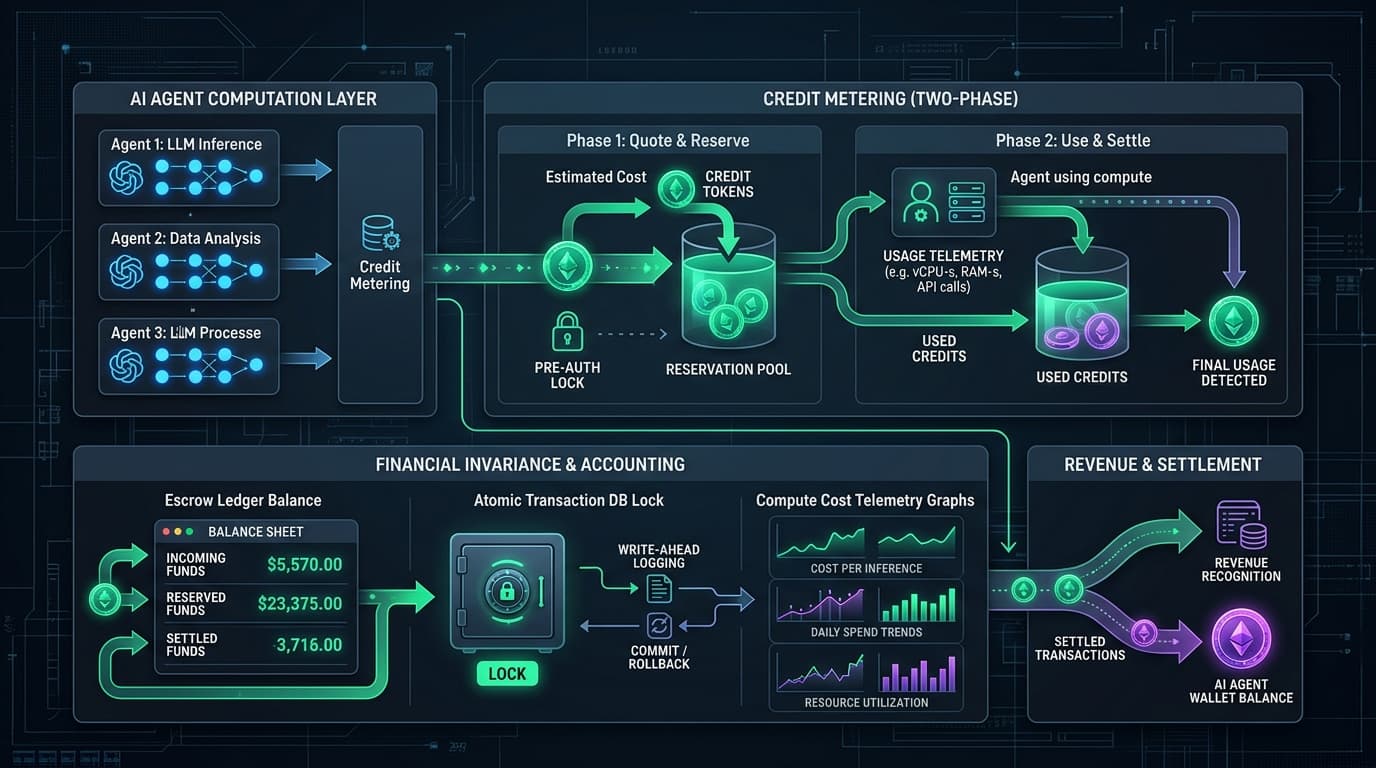
Architectural diagram illustrating two-phase financial credit reservation and settlement for autonomous AI agents

Two-phase financial credit reservation, settlement, and rollback lifecycle in CadreGPT.

The Looming Crisis of Runaway AI Cloud Bills

As enterprises scale from experimental single-prompt chatbots to autonomous multi-agent swarms, the economic model of AI infrastructure changes fundamentally. A single recursive agent trapped in an infinite planning loop or processing unexpected multi-megabyte payloads can consume thousands of dollars in commercial LLM tokens within hours.

Traditional post-execution billing ("charge the credit card at month-end based on accumulated API meters") is unacceptable for enterprise risk management. CFOs require hard mathematical invariance: compute must stop the moment authorized budgets are reached.


The Two-Phase Reservation Protocol

To achieve financial invariance, CadreGPT implements a two-phase credit reservation engine modeled after distributed two-phase commit protocols.

typescript
1. PRE-FLIGHT (Phase 1):
   Tenant Balance: $100.00
   Task Max Estimate: $3.50
   [ Escrow Reservation ] ──► Balance Held: $3.50 | Available: $96.50

2. LLM EXECUTION:
   Agent consumes 12,400 input tokens + 1,800 output tokens.
   Actual Provider Cost: $1.85

3. SETTLEMENT (Phase 2):
   Debited from Escrow: $1.85
   Released back to Available: $1.65 ($3.50 - $1.85)
   Final Tenant Balance: $98.15

Why Post-Execution Metering Fails

Under traditional post-execution models:

  • Five concurrent agents check balance simultaneously ($10 available).
  • All five proceed assuming sufficient funds.
  • Each agent runs up a $10 bill.
  • Total spend: $50 on a $10 account.

Under CadreGPT's upfront reservation model:

  • Agent 1 reserves $3.50 (Remaining: $6.50).
  • Agent 2 reserves $3.50 (Remaining: $3.00).
  • Agent 3 requests $3.50, is halted immediately due to insufficient escrow capacity.

Transaction Isolation & Zero Double-Spend Guarantees

In high-concurrency environments with dozens of active worker threads, wallet updates must be strictly serialized.

CadreGPT enforces SERIALIZABLE transaction isolation in PostgreSQL:

typescript
export async function reserveTaskCredits(
  tenantId: string,
  taskId: string,
  estimatedMaxCredits: number
): Promise<ReservationToken> {
  return await prisma.$transaction(
    async (tx) => {
      const wallet = await tx.tenantWallet.findUnique({
        where: { tenantId },
      });

      if (!wallet || wallet.availableCredits < estimatedMaxCredits) {
        throw new InsufficientCreditsError({
          required: estimatedMaxCredits,
          available: wallet?.availableCredits ?? 0,
        });
      }

      // Decrement available, increment escrow
      await tx.tenantWallet.update({
        where: { tenantId },
        data: {
          availableCredits: { decrement: estimatedMaxCredits },
          escrowCredits: { increment: estimatedMaxCredits },
        },
      });

      const reservation = await tx.creditReservation.create({
        data: {
          taskId,
          tenantId,
          reservedCredits: estimatedMaxCredits,
          status: 'HELD',
        },
      });

      return reservation;
    },
    { isolationLevel: Prisma.TransactionIsolationLevel.Serializable }
  );
}

Real-Time Token Telemetry & Stream Gauges

During streaming LLM executions, CadreGPT tracks incremental tokens generated in real time. If an output stream exceeds its declared max_tokens window or anomalous token velocity is detected, the socket connection is severed from the proxy side, preventing infinite loop generation.

Telemetry Benchmarks

  • Reservation Lock Time: 4.1ms average transaction duration.
  • Settlement Precision: 6 decimal places ($0.000001 precision) ensuring zero rounding drift.
  • Provider Pricing Engine: Sub-millisecond lookup from memory-cached rate cards across OpenAI, Anthropic, and Google Vertex AI.

Summary

Financial invariance transforms AI agent adoption from an unpredictable operational risk into a governed, forecastable utility. With two-phase reservations and serialized ledgers, engineering teams can deploy autonomous workflows with absolute confidence in cost containment.

Sarah Chen

Sarah Chen

Verified Enterprise Author

Staff Infrastructure & Data Systems Engineer

Distributed systems engineer focused on high-throughput ledger invariance, transactional guarantees, and cloud compute cost controls.

Frequently Asked Questions

Instead of post-billing for consumed tokens after execution, CadreGPT computes the maximum potential token cost before dispatching any API call. Credits are held in escrow; if the account balance is insufficient, the task is rejected upfront before consuming upstream LLM dollars.
Related Topics:#Financial Invariance#Credit Metering#Token Economics#Database Isolation#Enterprise AI#Architecture

Recommended Architectural Deep Dives

Governance

Human-in-the-Loop AI Governance: Architecting Deterministic Approval Gates in Enterprise Agents

How to architect deterministic human review gates, SSE approval drawers, BullMQ Redis locking, and state-machine invariance in enterprise AI agent platforms.

8 min readRead Deep Dive