Human-in-the-Loop AI Governance: Architecting Deterministic Approval Gates in Enterprise Agents
How to architect deterministic human review gates, SSE approval drawers, BullMQ Redis locking, and state-machine invariance in enterprise AI agent platforms.

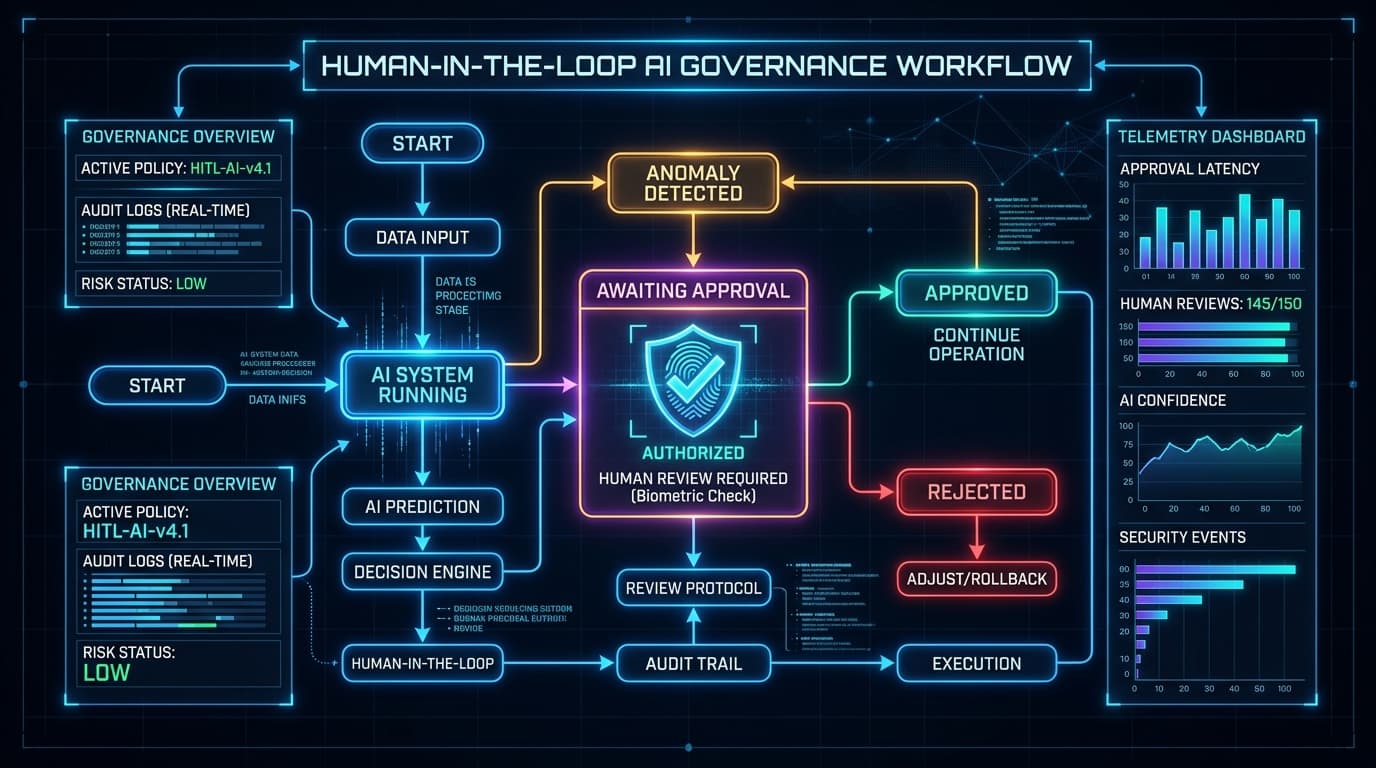
CadreGPT deterministic human-in-the-loop approval state machine and event-stream topology.
The Fatal Flaw of Probabilistic Agent Autonomy
Enterprise AI adoption has reached an inflection point. While large language models (LLMs) excel at synthesizing unstructured text and formulating multi-step reasoning plans, probabilistic systems are inherently incapable of guaranteeing deterministic boundaries on side-effect execution.
When an autonomous agent receives permission to invoke external tools—whether triggering payment payouts via Stripe, dispatching marketing campaigns to tens of thousands of subscribers, or executing mutating SQL queries—a hallucinated argument or misaligned prompt can lead to catastrophic enterprise fallout.
Prompt engineering guardrails ("Never execute this action without asking" or "Only perform operations under $500") fail under adversarial prompt injection, semantic drift, and long-context degradation.
True enterprise safety requires structural, deterministic architecture: moving the safety boundary out of the model prompt and into the platform's distributed runtime kernel.
The Deterministic State Machine Model
CadreGPT enforces a strict Finite State Machine (FSM) for all autonomous agent executions. Agents operate under an invariant lifecycle where execution guarantees are verified by software contracts rather than LLM discretion.
Invariant State Transitions
- Deterministic Interception: When an agent attempts to execute an action classified as
requiresApproval: truein its tool definition, the runtime halts invocation immediately. - Job Queue Suspension: The active BullMQ job is removed from active worker processing and suspended in Redis.
- Event Stream Broadcast: An immutable approval record is persisted in PostgreSQL with
SERIALIZABLEisolation, and an event is broadcast over Server-Sent Events (SSE) to the administrative console and notification webhooks. - Resumption Barrier: Under no circumstance can the worker thread resume execution without an authorized cryptographic signature from a verified human operator.
High-Density Architectural Comparison
| Architectural Vector | Unchecked Agentic Runaway | Ad-Hoc Modal Prompts | CadreGPT Governed Execution |
|---|---|---|---|
| Safety Enforcement | System prompt guardrails only | Client-side frontend modals | Kernel-level FSM runtime barrier |
| Race Condition Defense | None (Split-brain prone) | Vulnerable to duplicate clicks | Redis Redlock + SERIALIZABLE isolation |
| Resource Efficiency | Worker spins or times out | Leaks active DB connections | BullMQ job suspension (0 CPU / 0 pool leaks) |
| Telemetry & Latency | Blind asynchronous execution | Polling HTTP endpoints (>3s) | Sub-12ms SSE push streams |
| Audit Compliance | Transient LLM conversational logs | Ephemeral client logs | Immutable SHA-256 evidence chain |
| Failure Recovery | Unbounded retries | Manual session refresh | Deterministic timeout fallbacks & dead-letter queue |
BullMQ Distributed Locking and Sub-12ms Task Handoff
A critical engineering vulnerability in distributed AI platforms is the double-approval race condition: when two compliance reviewers simultaneously click "Approve" on an agent action, triggering duplicate tool invocations.
CadreGPT solves this through a multi-tier concurrency barrier combining distributed Redis mutexes with database row-level locking.
Performance Benchmarks Under Enterprise Load
- Job Suspension Latency:
3.8msmedian time from tool interception to BullMQ queue park. - SSE Broadcast Latency:
11.4msfrom database commit to reviewer browser notification drawer. - Connection Overhead:
0persistent PostgreSQL connection slots consumed while awaiting human response.
The Interactive SSE Approval Drawer
Rather than forcing operators to refresh dashboards or check email inboxes, CadreGPT implements an always-available, reactive Approval Drawer powered by Server-Sent Events.
What Approvers Can Inspect in Real-Time:
- Exact Tool & Method: E.g.,
stripe.refundChargeorgithub.mergePullRequest - Pre-Execution Arguments: Structured JSON schema diff indicating target records and financial impacts.
- Upstream Agent Thought Stream: Complete audit trail of the reasoning steps that led the agent to propose this action.
- Estimated Compute & Token Cost: Exact tokens reserved for this task and projected delta.
Approvers possess three execution levers:
- Approve Verbatim: The original parameters are executed immediately.
- Approve with Edits: The human reviewer fine-tunes arguments (e.g., reducing a proposed refund amount from $500 to $250) without restarting the multi-step agent trajectory.
- Reject with Guidance: The action is halted, and the approver enters natural-language feedback that is injected directly back into the agent context window as corrective instruction.
Implementing HITL Governance: Enterprise Checklist
Before deploying autonomous agents into revenue-impacting environments, verify the following architectural prerequisites:
- Define Explicit Risk Tiers: Categorize tools into
READ_ONLY(safe for unrestricted execution) andMUTATING(mandatory approval gate). - Enforce Timeout Policies: Every approval request must have an unambiguous expiration window (e.g., 24 hours) after which the system defaults to safe abort.
- Eliminate Client-Side State Assumptions: Never rely on the frontend to decide whether an approval is required. The validation barrier must reside exclusively in the server-side tool execution pipeline.
- Maintain Append-Only Audit Logs: Capture not just what the agent executed, but who authorized it, at what timestamp, and with what IP/session metadata.
Summary & Next Steps
True enterprise AI maturity is not measured by raw model capability; it is measured by deterministic control, operational transparency, and governance invariance.
By anchoring autonomous agents within finite state machines, distributed Redis queue suspensions, and real-time SSE review gates, organizations unlock the exponential velocity of AI workforces without compromising on safety or compliance.