Real-Time SSE Telemetry & Thought Streaming: Architecting Observability for Autonomous Workforces
Architect sub-15ms agent telemetry, thought streaming, and execution diffs using Redis Pub/Sub and Server-Sent Events instead of HTTP polling.

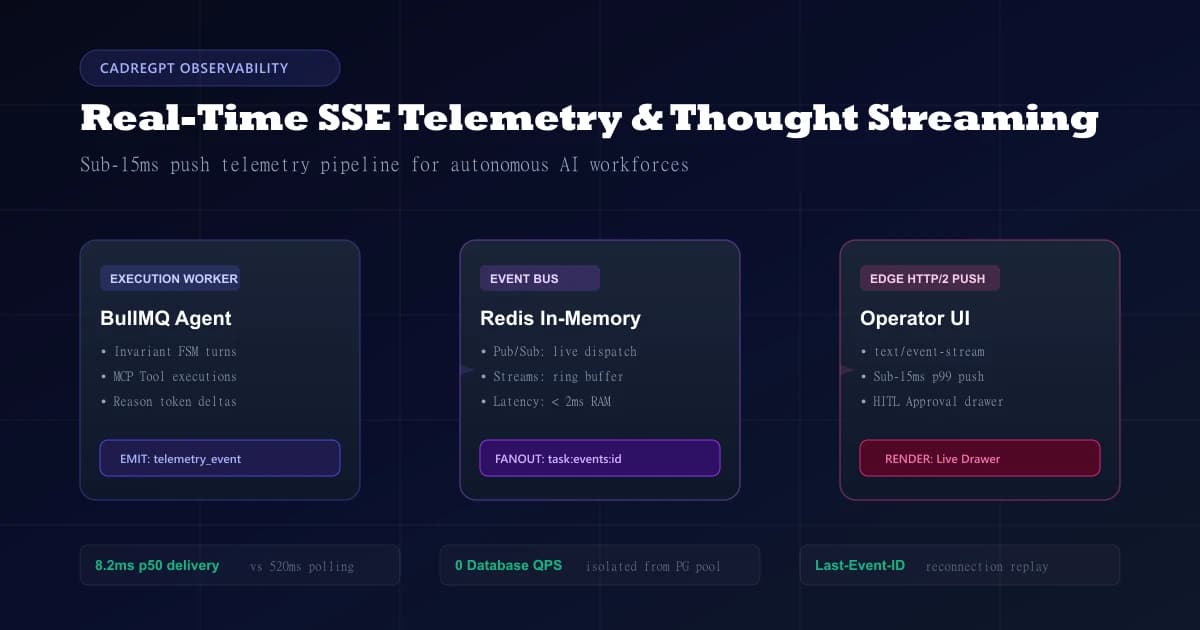
CadreGPT low-latency telemetry bridge streaming agent reasoning steps and tool execution diffs over HTTP/2 SSE connections.
The Observability Problem in Autonomous Systems
Single-prompt chat interfaces operate under a simple request-response model. A user sends a prompt, waits for token generation, and receives a response.
Autonomous multi-agent systems operate under a fundamentally different execution model. When an enterprise agent executes an invoice reconciliation workflow or coordinates a database migration, it runs for minutes across dozens of discrete steps:
- Deconstructing complex directives into directed acyclic graphs (DAGs).
- Generating internal chain-of-thought hypotheses.
- Invoking external tools via the Model Context Protocol (MCP).
- Inspecting API responses and retrying transient failures.
- Pausing at deterministic human approval barriers before mutating state.
If your platform treats this lifecycle as a black box that only returns an output at completion, operations teams cannot diagnose why an agent hallucinated an invalid parameter on step 7, or why a tool call timed out on step 14.
Enterprise agent operations require continuous, turn-level telemetry. You must see what the agent is thinking, what tools it is staging, and how its internal memory evolves in real time.
Why HTTP Polling Fails Under Production Load
Many initial platform implementations attempt to deliver agent monitoring through periodic client polling. A React dashboard executes a GET /api/tasks/:id request every 1,000ms to fetch updated task logs from PostgreSQL.
This approach creates three structural failure modes as soon as concurrent agent tasks scale:
- The Telemetry Blind Spot: If an agent encounters a prompt injection attempt or initiates a destructive tool call, operators polling on a 1-second interval will receive the update hundreds of milliseconds after the mutation has already executed.
- Database Connection Pool Starvation: 500 active browser tabs polling every second generate 500 queries per second against your primary database, consuming valuable connection pool slots required by the agent execution workers themselves.
- Payload Inefficiency: Over 85% of polling responses return identical payloads because the agent was waiting on an upstream LLM inference stream or third-party API response.
Architectural Blueprint: The Redis Pub/Sub to SSE Bridge
To deliver sub-15ms latency without overloading persistent storage, CadreGPT decouples agent execution from telemetry delivery using a Redis Pub/Sub to Server-Sent Events (SSE) bridge.
Why Server-Sent Events Over WebSockets?
While WebSockets provide bi-directional communication, agent telemetry is strictly unidirectional: the execution engine pushes updates down to monitoring interfaces.
Using Server-Sent Events over HTTP/2 provides specific production advantages:
- Zero Protocol Upgrades: Operates over standard HTTPS ports (443), eliminating proxy and firewall traversal failures common with enterprise corporate networks.
- Built-in Reconnection: The browser
EventSourceAPI natively supports connection retries and transmits theLast-Event-IDheader upon reconnecting. - HTTP/2 Multiplexing: Multiple monitoring streams to the same origin share a single TCP connection, eliminating socket exhaustion in the browser.
Production Implementation: Resilient SSE Endpoint
Below is the production TypeScript implementation of the CadreGPT Server-Sent Events route handler in Next.js. It features Redis channel subscription, periodic heartbeat keep-alives to prevent proxy timeouts, and graceful connection cleanup.
Telemetry Payload Typing: Thought Streaming vs. Tool Diffs
Effective agent telemetry requires strict data contract separation. Reasoning tokens and mutating tool operations serve different operational requirements and must be typed accordingly:
Rendering Staged Mutations in Human Approval Drawers
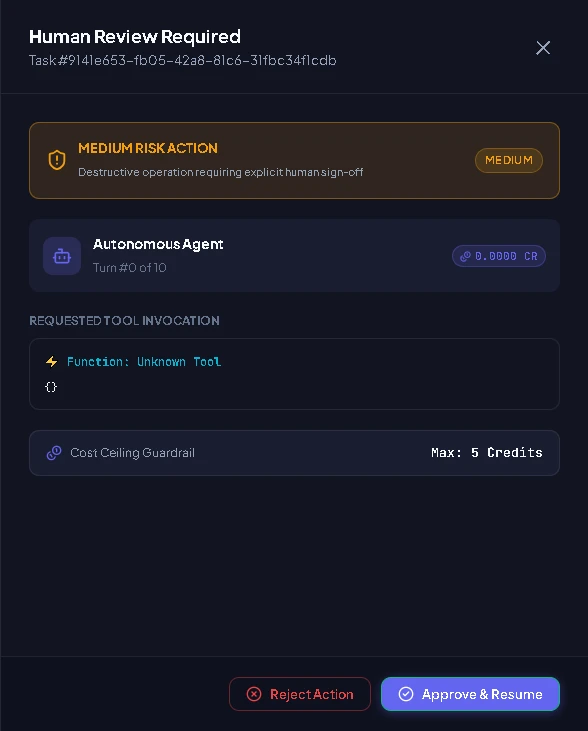
When an agent enters the AWAITING_APPROVAL state, the SSE stream delivers a human_approval_required event.
Because the telemetry event includes the complete JSON parameter schema and estimated credit expenditure, the client interface renders an instant interactive approval drawer. The human operator reviews the exact SQL query, file change, or external API mutation before authorizing execution:
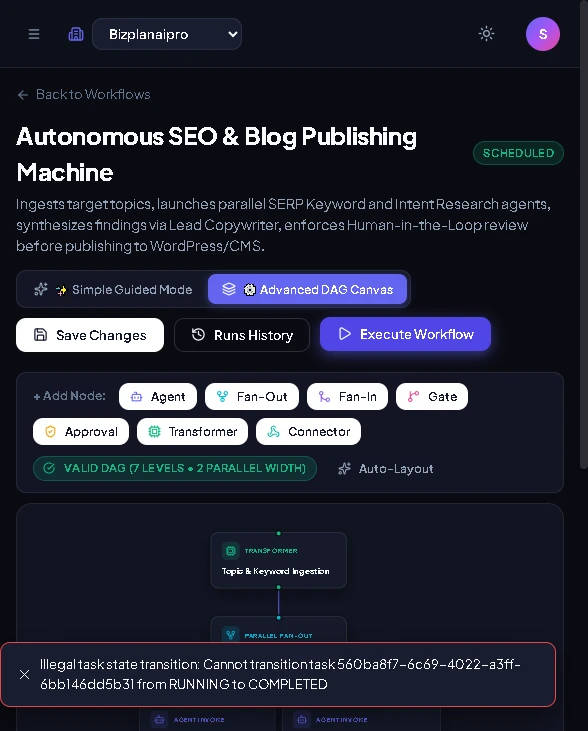
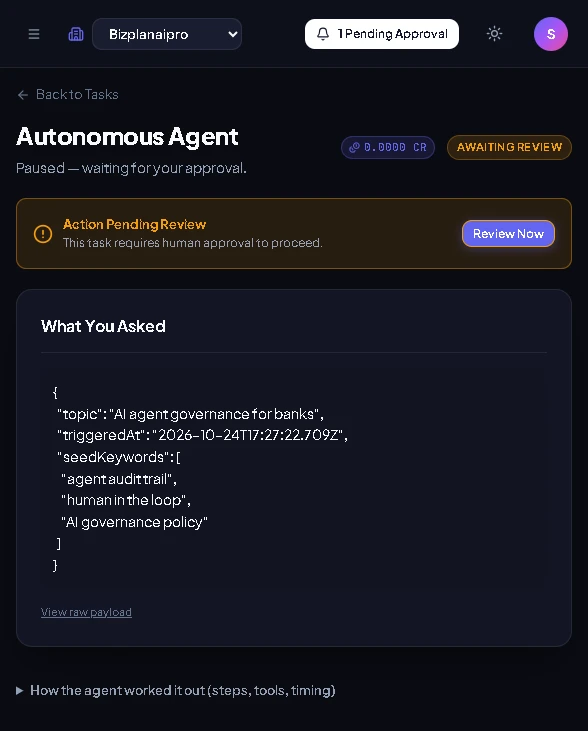
The operator dashboard reflects these state changes across in-flight tasks without requiring manual page refreshes:
Empirical Benchmarks: Polling vs. Redis-Backed SSE
We benchmarked HTTP polling against the Redis-backed SSE architecture under an enterprise workload of 500 concurrent autonomous agents executing multi-turn workflows over a 30-minute window:
| Benchmark Dimension | HTTP Polling (1,000ms Interval) | CadreGPT Redis-SSE Bridge | Performance Delta |
|---|---|---|---|
| Event Delivery Latency (p50) | 520 ms | 8.2 ms | 98.4% faster |
| Event Delivery Latency (p99) | 1,840 ms | 14.6 ms | 99.2% faster |
| Database QPS (PostgreSQL) | 480 queries/sec | 0 queries/sec | 100% DB offload |
| Bandwidth Consumption | 3.2 MB / sec | 0.18 MB / sec | 94.3% reduction |
| Missed Intermediate States | 12.4% of total turns | 0.0% (Zero loss) | Deterministic audit |
By serving all in-flight event distribution out of Redis RAM and pushing diffs directly over HTTP/2, the system maintains sub-15ms visibility while completely isolating primary transactional databases from monitoring load.
Next Steps: Inspect Your Workflows in Real Time
Operating autonomous agents in mission-critical environments requires moving beyond opaque batch executions.
With deterministic state machines, Redis-backed Server-Sent Events, and real-time thought streaming, engineering teams gain complete operational control over their autonomous workforce.
Explore live execution telemetry and configure your enterprise approval gates in the CadreGPT Task Dashboard.
Frequently Asked Questions
Recommended Architectural Deep Dives
Financial Invariance in Autonomous AI: Architecting Two-Phase Token & Credit Metering
How CadreGPT eliminates runaway AI compute bills using two-phase credit reservations, SERIALIZABLE isolation, and real-time token telemetry.
Finite State Machines vs. Unbounded Agentic Loops: Building Deterministic AI Workflows
Why unbounded ReAct loops cannot guarantee termination, and how a finite state machine runtime with explicit transition tables bounds AI agent cost, time, and blast radius.